

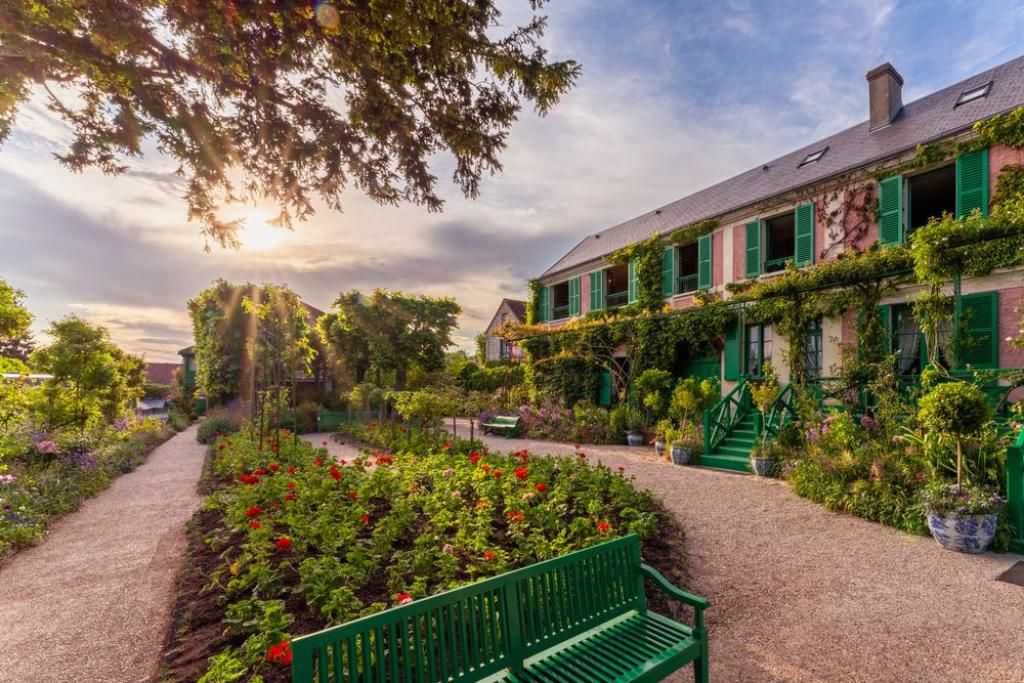
Giverny - Claude Monet's House and Gardens
Categories : Leisure, published on : 4/10/23
The Claude Monet House and Gardens - Giverny offer everyone the opportunity to share the intimacy of the master of the house in his home, to discover, like his friends of yesteryear, the exceptional collection of Japanese prints, to be as enthusiastic as he was before the incredible richness of the blooms of the Clos Normand, to experience the intact emotion delivered by the Water Garden; to live a time apart, bathed in this very particular light that he had been able to recreate in his paintings.
When he settled in Giverny, a small village in the Normandy region located on the border of Yvelines in Ile-de-France, on April 29, 1883, Claude Monet, the Master of Impressionism (Paris, November 14, 1840 – Giverny, December 5, 1926) became passionate about gardening.
First, the Clos Normand, and then, from 1890 onward, the Water Garden, bear witness to his passion for plants, but also for their "staging," where he revealed an extraordinary originality, creating two gardens unlike any other.
Surrounding himself with the expert advice of Georges Truffaut, exchanging experiences with his friends Gustave Caillebotte and Octave Mirbeau, both skilled gardeners, an avid reader of nursery catalogs, and frequenting plant exhibitions and botanical gardens, Claude Monet invented gardens that evoked his paintings, always in motion, where light reveals colors in perpetual vibration.
Gradually neglected after the painter's death, the gardens were restored starting in 1977 before being opened to the public on June 1, 1980.
From April to October, the gardens offer a succession of remarkable blooms. Bulbs, annuals, biennials, spring and summer perennials, water lilies, flowering shrubs, roses, peonies, perennials, and autumn foliage—thousands of plant varieties punctuate the life of these extraordinary gardens.
Here, visitors are invited to a unique experience: to enter the very heart of the painter's imagination.
Another passion of Claude Monet's, Japanese prints, which he began collecting in the 1870s, are displayed in the house.
Among the 211 prints exhibited, visitors will discover coherent sets bearing the stamps of Utamaro, Hokusai, and Hiroshige.
Claude Monet shared with his Impressionist painter friends a genuine fascination for the culture and artistic expressions of the Land of the Rising Sun. The collection assembled at Giverny is also of historical interest, as it has been preserved almost entirely intact.
Like the gardens, the house was restored between 1977 and 1980.
The tour offers a glimpse into the world in which the painter and his large family lived – he himself had two sons, later joined by the six children of his second wife, Alice Hoschedé.
On the ground floor, beyond the small "blue room," or reading room, the door opens onto the original studio, which was transformed into a living room when Monet set up a new studio outside the house.
On the first floor, the painter's and Alice's bedrooms each open onto a bathroom.
Finally, the last room on this floor is Blanche Hoschedé-Monet's bedroom, which was opened to the public for the first time in 2014.
Back on the ground floor, visitors enter the welcoming dining room, decorated in two shades of yellow, reminiscent of Monet's time, which seems to await new guests. Covered in blue Rouen tiles, the kitchen was the heart of the home; the painter's table was considered exceptional and was meticulously cared for.
At the end of the visit, everyone feels as though they have shared in the intimacy of Claude Monet's family life.
Enjoy your stay at the Hotel Jardin Le Bréa between April and November by visiting the house and breathtakingly beautiful gardens of the renowned Impressionist painter Claude Monet.
While in Giverny, be sure to also visit the Museum of Impressionism, located nearby.
Back in Paris, continue your exploration of Claude Monet's work and visit the Orangerie Museum, home to eight monumental canvases, including the famous Water Lilies, as well as many other paintings.
Continue your journey to the Orsay Museum, which displays nearly 150 works by Claude Monet, including Luncheon on the Grass, Poppies, Woman with a Parasol, Landscapes at Étretat, Gare Saint-Lazare, Rouen Cathedral, and the famous Haystacks.
Finally, conclude your tour at the Marmottan Monet Museum, which also houses several works by the master, including the essential Impression, Sunrise, as well as several paintings and studies of Water Lilies, Train in the Snow, Strolling Near Argenteuil, Pont de l'Europe, Gare Saint-Lazare, London, the Houses of Parliament, and Reflections on the Thames.
How to get to Claude Monet's House and Gardens in Giverny from the Hotel Jardin Le Brea?
Claude Monet's House and Gardens - Giverny - 84, rue Claude Monet - 27620 Giverny
Open from April 1st to November 1st only
- From the Hotel Jardin Le Brea, take metro line 12 to Notre-Dame-des-Champs (5-minute walk), direction Mairie d'Aubervilliers, and get off at Gare Saint-Lazare station. Then take the TER train to Vernon-Giverny, where you can catch a shuttle bus that will take you directly to Claude Monet's house.
The total travel time from our hotel to Claude Monet's House in Giverny is approximately 1 hour and 30 minutes.
Practical Information
https://claudemonetgiverny.fr/en/
©Claude Monet House and Gardens Giverny - all rights reserved